
Reviewed · ALCUDIA TOURS
Coasteering northern area Mallorca (Alcudia)
Cliffs, water, and big drops in Alcudia. This coasteering circuit on the Alcudia cliffs packs real variety into about 3 hours, with jumps, a rappel, and marine tunnels all along the northern coast.
What I like most is the steady mix of thrills and choice points. There are roughly 7 to 8 water jumps with heights from 2 to 7 meters, so you can feel the progression without it being one endless fear test.
One thing to keep in mind: this activity needs good weather. If conditions are poor, the operator will move you to another date or issue a full refund, so plan around that flexibility.
In This Review
- Key highlights you’ll feel fast
- Coasteering on Alcudia’s northern cliffs, what the 3-hour circuit really feels like
- The jumps (2m to 7m), how to judge the nerve before you step off
- Psychobloc crossing at up to 2 meters, the rope-free mental test
- The 8-meter rappel, why the big descent is the safety anchor
- Marine tunnels, when the coast turns into a water route
- Price and value, is $78.64 a fair deal for 3 hours?
- Meeting point, timing, and the small-group advantage in Cielo de Bonaire
- Who this is perfect for, and who should think twice
- How to decide on booking, use these 4 checks
- Should you book coasteering in Alcudia with Mes Aventura?
- FAQ
- Where does the coasteering start in Alcudia?
- What time does the activity start?
- How long is the coasteering session?
- How much does it cost?
- Is the tour offered in English?
- How many people are in the group?
- What are the main activities included?
- Do I need good weather for this experience?
- What happens after booking if the weather is bad or if the minimum group size is not met?
Key highlights you’ll feel fast
- Jumps from 2 to 7 meters, roughly 7 to 8 entry moments into the sea
- Psychobloc crossing, rope-free, up to about 2 meters from sea level
- 8-meter rappel, one controlled descent that adds a big wow factor
- Marine tunnels, so the route includes waterway sections, not just open coast
- Small group size (max 12), which helps the guide manage different comfort levels
Scramble the rocks, then jump in
- Mallorca: Kayaking, Sea Cave, Cliff Jumping & Snorkel Tour
★ 4.8 · 1,447 reviews - Mallorca: Kayaking, Sea Cave, Cliff Jumping & Snorkel Tour
★ 5.0 · 769 reviews - Mallorca: Half-Day Coasteering Experience
★ 4.7 · 447 reviews
Coasteering on Alcudia’s northern cliffs, what the 3-hour circuit really feels like
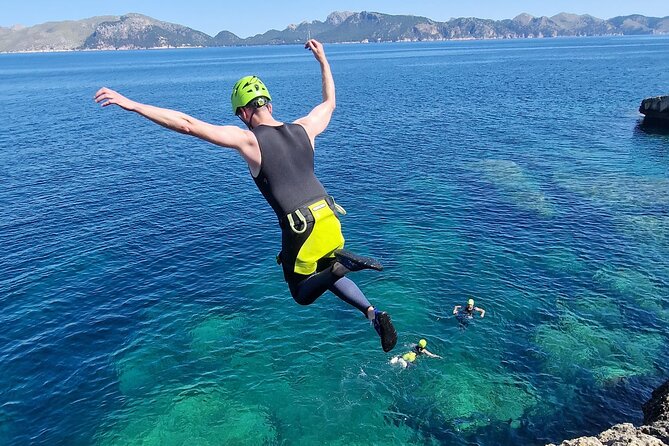
Coasteering here is built around one idea: using the coastline itself as your route. You’ll be working along the cliffs in the northern area near Alcudia, and the adventure stays active for about 3 hours rather than turning into a long, slow walk. The payoff is that you’re not just looking at the coast from above, you’re moving through it.
If you want a clear sense of the physical vibe, think mixed effort. Some parts are about commitment, like stepping out for a jump. Other parts are about technique and composure, especially when you’re moving near the waterline, then later doing an 8-meter rappel. This is the kind of outing that rewards staying calm and listening closely to the guidance.
I also like the practical setup for this style of day. It’s offered in English, and the group is capped at 12 people, which usually means you get more personal attention than you would on bigger adventure trips. And it runs from a specific start point, Carrer Fonoll, 8, 07400 Cielo de Bonaire, with the activity ending back there too.
The jumps (2m to 7m), how to judge the nerve before you step off
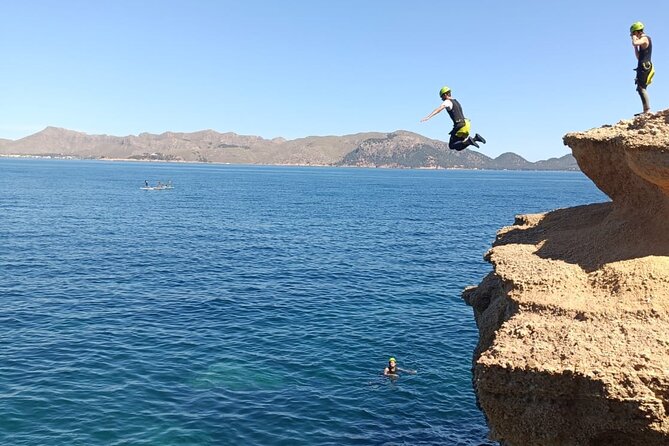
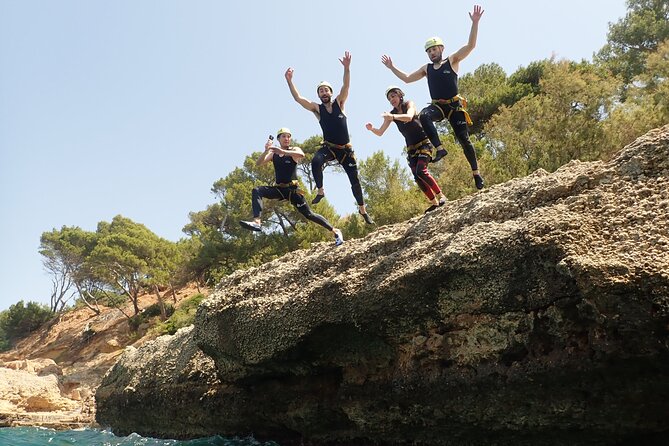
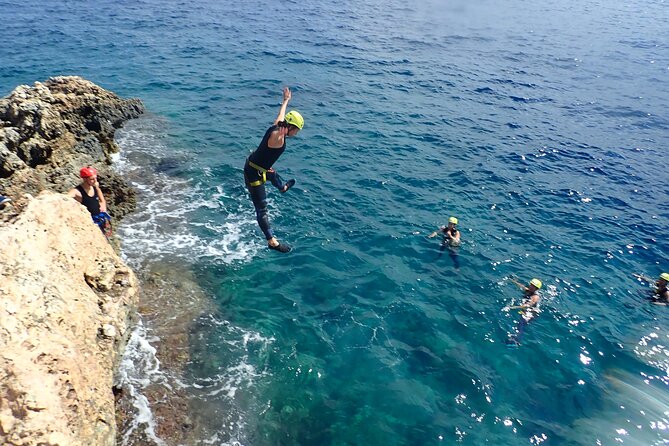
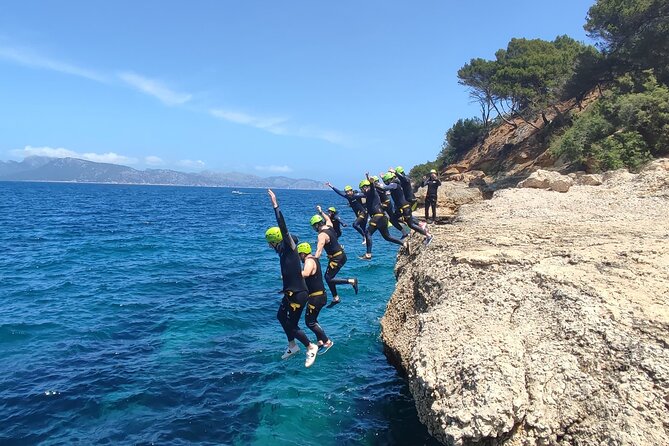
The headline action is the series of jumps into the water. You’re looking at 7 to 8 jumps, with heights ranging from about 2 meters up to 7 meters. That range matters for your planning, because it turns the day into a ramp-up. A lower jump helps you lock into the rhythm, and a higher one gives you that proper adrenaline hit.
Here’s how I’d think about it if you’re nervous about heights or the feeling of emptiness. The key is not whether you are afraid, it’s whether you can follow the plan while your body is doing the fear thing. The review highlight I kept coming back to mentions Paco adapting to each person’s abilities. That’s exactly what you want from a coasteering operator: not forcing everyone through the same level of intensity, but helping you do it in a way you can actually manage.
Your takeaway: if you can swim and you’re willing to commit to the sequence, the jumps become more about trust and breathing than about being fearless. The heights are not tiny, but the structure of multiple jumps means you’re not thrown straight into the deepest end of the scale.
Possible drawback: if you freeze mentally on the first higher jump, it can make the rest of the day feel heavier. If you’re the kind of person who needs a minute to settle, plan to use the early moments to get comfortable with the pace.
Psychobloc crossing at up to 2 meters, the rope-free mental test
Next comes one psychobloc crossing, which is described as climbing without a rope, at a maximum of about 2 meters from sea level. That detail is important. Two meters doesn’t sound huge until you realize it’s rope-free and closer to water, which changes your risk perception.
What makes psychobloc stand out in a day like this is that it’s not only about strength. It’s about decision-making under slightly weird conditions, where you need to move confidently and keep your focus on the next move rather than what happens if you hesitate.
For your own comfort, remember the focus is still coasteering, not sport climbing. You’re doing it as part of a coastal route that includes jumps and a rappel later. So if you approach it as a short, targeted challenge rather than a big standalone event, it tends to feel more manageable.
The 8-meter rappel, why the big descent is the safety anchor
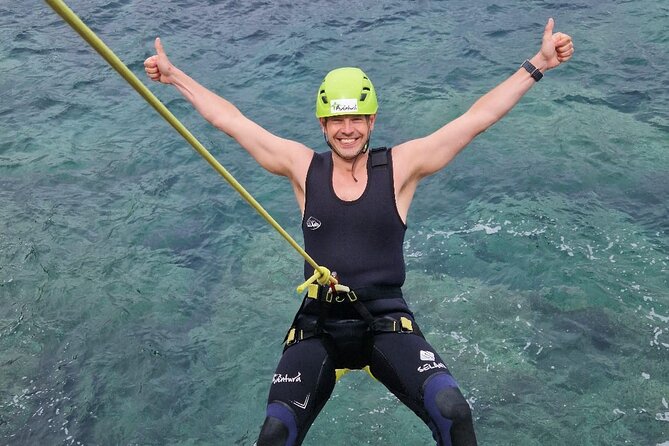
Then you get the 8-meter rappelling section. A rappel is often the moment people remember most, not because it’s the hardest thing physically, but because it feels like the clearest technical move of the day: controlled descent, hand placement, and steady body position.
An 8-meter rappel also acts like a safety anchor for the day. After a series of jumps and a rope-free climbing crossing, it’s reassuring when one section is structured around a clear technique. Even if you’re not a frequent adventurer, rappelling usually feels more predictable than a jump, because the process is more step-by-step.
A practical consideration for anyone with a fear of heights: the rappel gives you time to focus on what your body is doing. With jumps, you have a moment of commitment. With a rappel, you can slow down and keep adjusting. That difference is why the rappel can be a turning point in the experience rather than just another thrill.
Roman ruins and a walled old town
Marine tunnels, when the coast turns into a water route
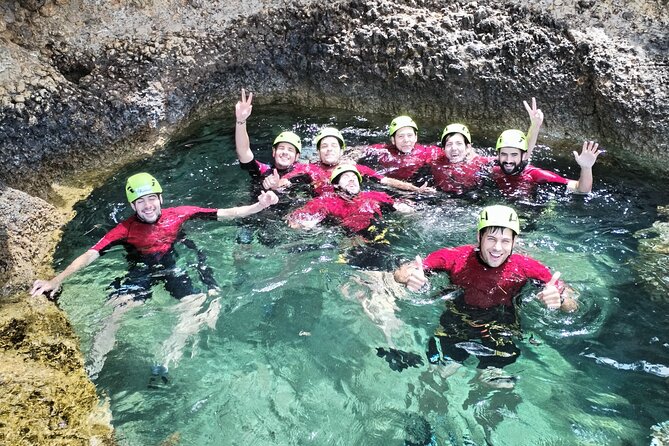
You also enter marine tunnels as part of the circuit. That’s where coasteering in this area feels especially different from just jumping off rocks.
The value of tunnel sections is that they change the sensory experience. You go from open cliff views to enclosed rock and seawater passages, and your attention shifts to movement and timing. It’s also a reminder that you’re not in a swimming pool. You’re in a coastal environment where the route is shaped by geology.
I’d treat the tunnels as a key reason to do this specific Alcudia coast version. Many “jump and swim” style outings skip the enclosed sections. Here, the tunnels help keep the day from becoming repetitive.
Price and value, is $78.64 a fair deal for 3 hours?
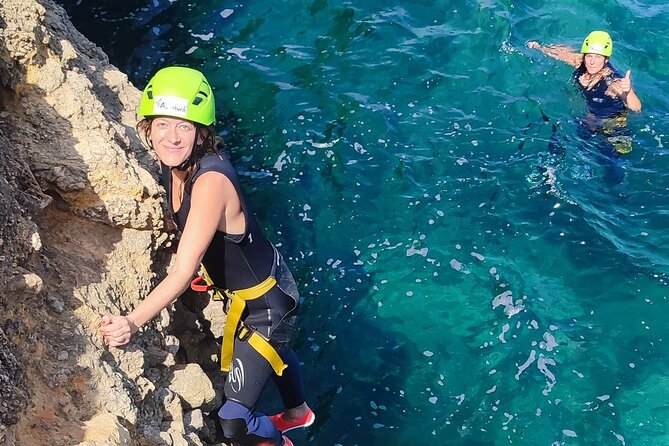
The price is $78.64 per person for roughly 3 hours of guided activity, offered in English, with a group cap of 12. On paper, that’s not a bargain-basement cost. But in adventure travel, you’re paying for more than movement. You’re paying for a setup that can handle a range of heights, a rope-free crossing, rappelling, and tunnel entry.
Here’s the value logic I’d use:
- You’re getting multiple distinct components, not just one big stunt.
- The group size cap means you likely get closer attention than you would in larger crowds.
- You’re paying for the equipment and safety system required for jumping, psychobloc, and rappelling, plus someone managing the coastal route.
If you’re going because you want one or two jumps for photos, this might feel pricey. If you’re going because you want a structured coasteering circuit with real variety, the cost is easier to justify.
Meeting point, timing, and the small-group advantage in Cielo de Bonaire
You meet at Carrer Fonoll, 8, 07400 Cielo de Bonaire, Illes Balears, Spain, and the session starts at 10:00 am. The activity ends back at the same meeting point.
That matters more than people think. When tours finish at the start, you don’t spend the afternoon guessing transport. It also helps if you plan to pair this with a beach or meal afterward, because you can build your schedule around a clean return.
The small group limit of 12 is another quiet win. It tends to improve flow. You’re not watching a huge line of people do the same step. You’re doing a sequence where the guide can manage spacing and keep the pace moving.
It’s also offered with a mobile ticket, and it’s marked as near public transportation. So if you’re not renting a car, you still have options.
Who this is perfect for, and who should think twice
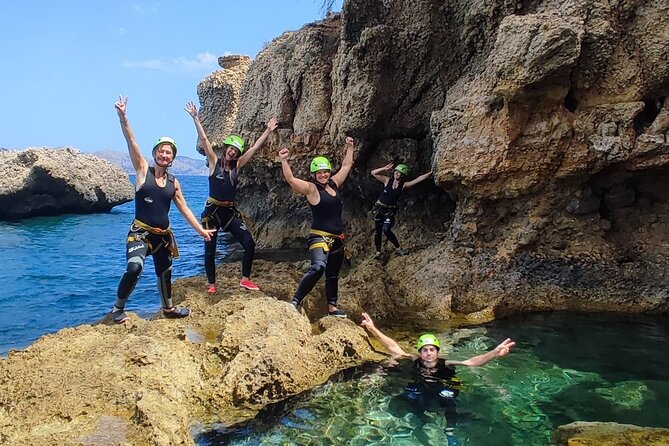
This coasteering experience is described as something most people can participate in, with the big condition that you can swim. One review also calls out that Paco adapts to everyone so that people can do the activity according to their abilities. That is the kind of guidance you want if you’re not an expert athlete but you’re eager to try.
Best fit:
- You’re comfortable getting into the ocean and can swim confidently.
- You want a mix of jumps, a rope-free challenge, and a rappel within one circuit.
- You like adrenaline with structure, not chaos.
Think twice if:
- You know you’ll panic at the idea of rope-free climbing, even at around 2 meters.
- You have a strict schedule and can’t flex if weather causes a reschedule or refund.
- You’re not comfortable with heights in the 2 to 7 meter jump range.
How to decide on booking, use these 4 checks
If you’re standing at the decision point, don’t focus only on the big numbers like 7 meters and 8 meters. Use these checks.
1) Are you comfortable swimming enough to handle open water entry after jumps?
2) Are you okay with a rope-free psychobloc section, even if it’s capped around 2 meters?
3) Can you keep your day flexible if weather changes? The tour requires good weather and may be moved.
4) Do you want a small-group guided circuit with multiple elements, not a single stunt?
Should you book coasteering in Alcudia with Mes Aventura?
If you want a true northern Mallorca coast experience, this is a strong choice. The combination of 7 to 8 jumps, psychobloc, an 8-meter rappel, and marine tunnels turns a half-day into a full set of different challenges. That mix is also where the value comes from, because you’re not paying for one action, you’re paying for a whole circuit.
Book it if you can swim, you can handle a fear spike, and you’re okay with weather depending on the day. I’d especially lean toward it if you appreciate a guide who adapts, like Paco, because that can be the difference between doing the course confidently and spending the session fighting your own panic.
Skip it if you’re fragile with open-water comfort or you cannot reschedule if the weather turns. And remember the cost is non-refundable with no changes once booked, so make sure your timing is solid before you lock it in.
FAQ
Where does the coasteering start in Alcudia?
The meeting point is Carrer Fonoll, 8, 07400 Cielo de Bonaire, Illes Balears, Spain.
What time does the activity start?
The start time is 10:00 am.
How long is the coasteering session?
It runs for about 3 hours.
How much does it cost?
The price is $78.64 per person.
Is the tour offered in English?
Yes, it is offered in English.
How many people are in the group?
The tour has a maximum of 12 travelers.
What are the main activities included?
You can expect around 7 to 8 jumps into the water (between 2 and 7 meters), one psychobloc crossing (no rope, up to about 2 meters from sea level), one rappelling of 8 meters, and entry into marine tunnels.
Do I need good weather for this experience?
Yes. It requires good weather. If it is canceled due to poor weather, you’ll be offered a different date or a full refund.
What happens after booking if the weather is bad or if the minimum group size is not met?
If it’s canceled because of poor weather, you’ll be offered a different date or a full refund. If it’s canceled because the minimum number of travelers is not met, you’ll be offered a different date or experience or a full refund.
Fresh on the Island
- History, Architecture and Legends of Palma de Mallorca★ 5.0 · 1 review
- Deluxe Excursion in Palma De Mallorca and Valldemossa★ 5.0 · 1 review
- Palma de Mallorca Private Boat.Adventure from the Sun to the Stars★ 5.0 · 1 review
- Half-day trip to the Drach Caves★ 5.0 · 1 review
- Mallorca: 4-Hour Retreat of Yoga, Meditation & Magic Vibes★ 5.0 · 1 review
- Mallorca: individually guided hiking tours, city, coast, almond blossom★ 5.0 · 1 review
- 8-Hour Formentor and Sineu Market with boat trip Tour in Mallorca★ 4.0 · 1 review
- Catamaran Trip in Alcudia★ 4.0 · 1 review
Alcudia Tours, compared.
Alcudia or Can Picafort: Dolphin-Watching Cruise
Read our review →
Formentor Beach, Lighthouse Cruise, and Small Group
Read our review →
Cap de Formentor: Market, Beach, and Alcudia Tour
Read our review →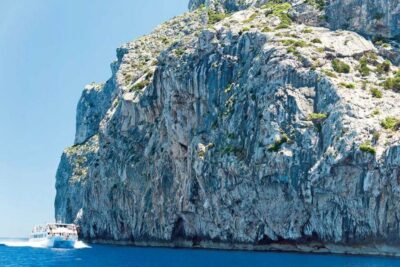
Browse the lists this tour appears in